Recent

For reasons unbeknownst to me, the algorithm decided to surface a lot of people talking about the upcoming change in the MLS schedule for the 2027/28 season. Maybe it’s the crisp fall air, the departure from the hottest summer I’ve ever experienced, people excited for a super El Nino, I don’t know.
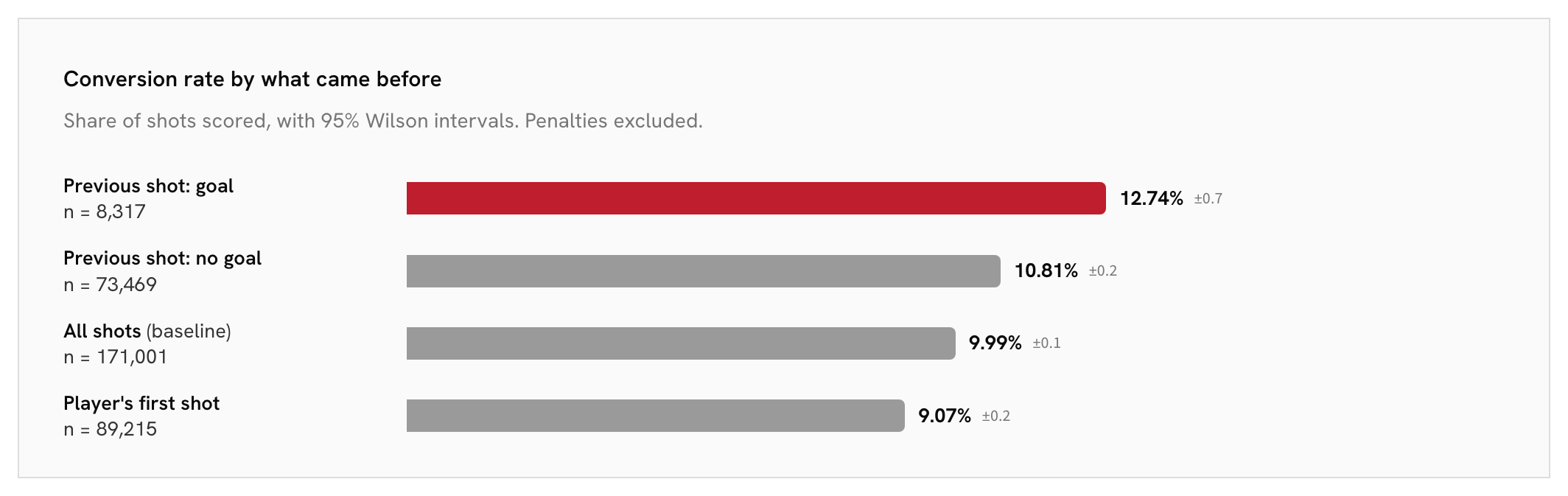
Finishing is a fairly contentious topic when it comes to the world of soccer analytics. The somewhat mainstream analytics practitioner opinion can be summed up as follows: finishing is objectively a skill that exists, but the majority of players possess a skill level that impacts the underlying finishing rate to a much smaller degree than the random noise of sometimes ball go in. This is the thing with soccer as a sport as a whole. Feet are just so much worse than hands. One topic that this has made me think about is the whole hot hand fallacy. Do feet, which are much less good at manipulating balls than hands, get hot? I’m going to try and avoid being too academic and stiff here, but bear with me.
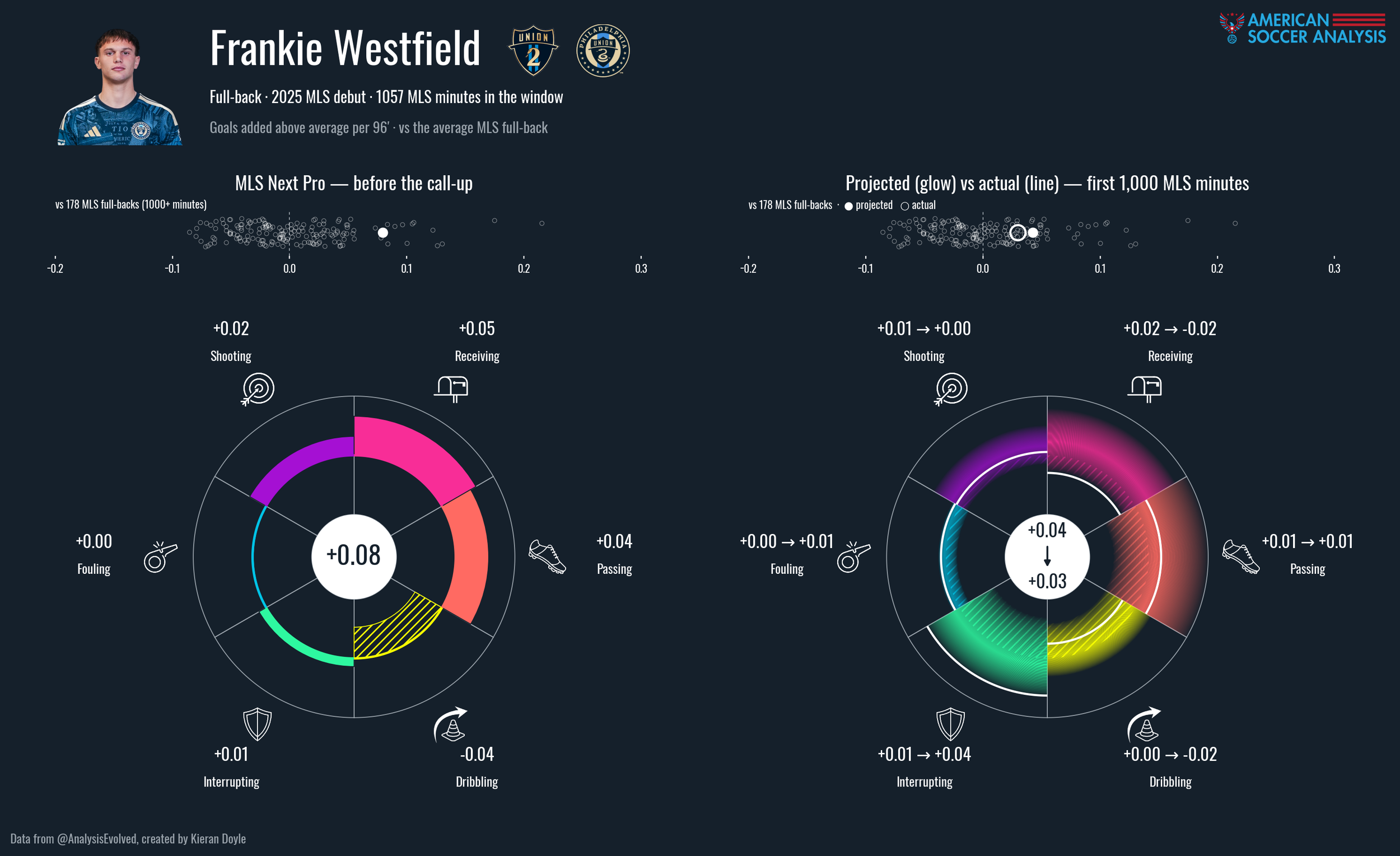
In 2022, Daniel Dinsdale and Joe Gallagher of Stats Perform (the artist formerly known as Opta) released an arXiv of a paper titled “Transfer Portal: Accurately Forecasting the Impact of a Player Transfer in Soccer”. The paper is a worthwhile read, but the idea can sort of be summed up as the three approaches.
Identify how the player is currently doing on a per 90’ basis, for the metrics you care about.
Identify how their team and league fits into the global hierarchy, in relation to other teams and leagues.
For players with insufficient data, weight the average of their small data sample and some prior for the league/age/position etc.
Then take all those things, stick it in some neural networks, and try to predict the impact if that player moved from team A to team B. And it works! It’s a pretty good predictor of how players do when they move clubs, reducing mean squared error by 50% compared to assuming their performance translated over one-to-one. This is a cool result, and league translation/transfer projection is an extremely difficult task.
Where my brain went when I read this paper six years ago was, wow, this would be a great approach to trying to figure out how good young players might be. Three months after this, MLS Next Pro started its inaugural season, in March of 2022. While Opta’s work on this was based on some 26,000 samples and 2600 transfers, after four seasons of MLS Next Pro we certainly don’t have 2600 players graduating to their first team, but we might have enough to try.
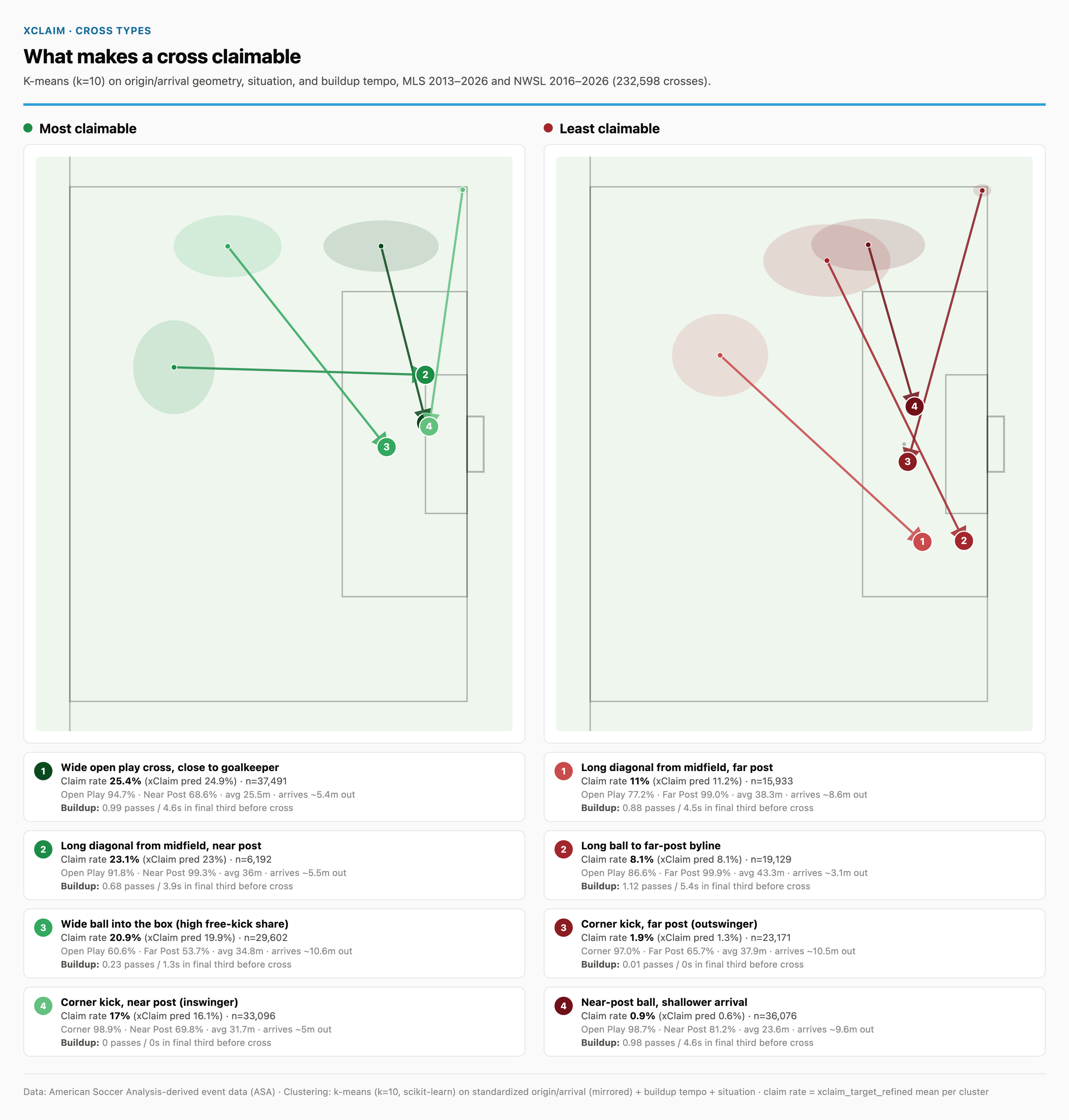
Ever since we built goals added (g+) oh so many years ago, I’ve largely been unhappy with how we’ve treated goalkeepers here at ASA. ASA, the masterful puppeteer in the shadows crafting the rise of Matt Turner and Djordje Petrovic to the Premier League, letting them down! And so, my fellow analytics practitioners, ask not what your goalkeeper can do for you, but what you can do for your goalkeeper.
ASA and the analytics community at large has gotten to a pretty good place with goalkeeper shotstopping, at least with event only data. You scale the saves they make by the quality of chances they face, you accept that’s a pretty noisy metric season to season, it tracks directly to goals, it’s sort of easy. We have done a somewhat less good job looking at how the other parts of being a goalkeeper impact the game. Goals added does an okay job, assigning the value of their sweeping to the situations they interrupt. But it’s an imperfect picture, the whole point of sweeping is that you are preventing a much more dangerous situation from occurring further down the road, but where you are now is not actually that dangerous on its own. The ball playing side is similar, goalkeepers are so far from goal that aside from long kicks up the field, virtually all the passing they do is meaningless in the eye of a possession value model.
Today, though, we start with cross claiming. If you take the entire MLS dataset we have at ASA, the most productive cross claiming season by g+ is about +0.5 g+ across the entire season. Half a goal. Intercepting a cross in the 6 yard box off the head of a striker itself is worth half a goal! It’s wrong, and I won’t stand for this goalkeeper cross claiming erasure #GKUnion.
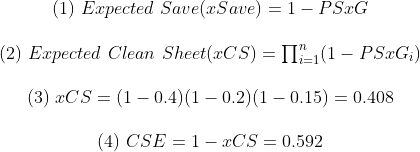
At the end of a season in soccer, the Golden Glove is awarded to the goalkeeper that has kept the most clean sheets. It seems intuitive, as being the last line of defense, their job is mainly to stop any shots that make it past the defense from entering the goal. However, a clean sheet is when the team prevents their opponent from scoring, not just the goalkeeper; it’s a team effort.
